$24 an Hour is How Much a Year?
$24/hour × 2,080 hours = $49,920/year before taxes. After federal income tax and FICA, a single filer in a no-tax state takes home approximately $42,149/year ($3,512/month). This guide breaks down every pay period, the federal minimum wage gap this closes, and a realistic monthly budget.
$24 an Hour is How Much a Year?
Working full-time at $24/hour means $49,920 per year before taxes. Here is the full pay period breakdown:
| Hourly | $24 |
| Daily (8 hours) | $192.00 |
| Weekly (40 hours) | $960.00 |
| Bi-weekly (80 hours) | $1,920.00 |
| Semi-monthly (twice/month) | $2,080.00 |
| Monthly | $4,160.00 |
| Annual | $49,920 |
$24 an Hour After Taxes
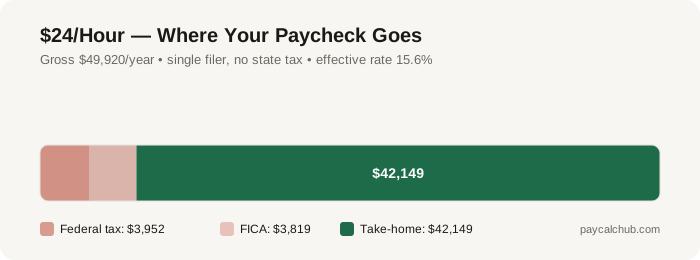
Your actual take-home pay depends on your filing status, state, and deductions. For a single filer with no pre-tax deductions, here is what you keep after federal income tax and FICA:
| Gross annual income | $49,920 |
| Federal income tax (est.) | -$3,952 |
| FICA (Social Security + Medicare) | -$3,819 |
| State income tax (varies) | -$0 to -$4,992 |
| Annual take-home (no state tax) | $42,149 |
| Monthly take-home | $3,512 |
| Bi-weekly take-home | $1,621 |
| Effective federal + FICA rate | 15.6% |
After-Tax Pay by State
State income taxes vary significantly. Here is estimated annual take-home at $24/hr across key states (single filer, standard deduction):
| No state income tax (TX, FL, WA, NV…) | $42,149 |
| Pennsylvania (3.07%) | $40,616 |
| Illinois (4.95%) | $39,678 |
| Georgia (5.49%) | $39,408 |
| New York (est. 5.5%) | $39,403 |
| Virginia (5.75%) | $39,279 |
| California (est. 6.5%) | $38,904 |
Is $24 an Hour a Good Wage?
At $24/hr, a single adult can live comfortably in most US cities and begin building savings and retirement contributions.
For context, the federal minimum wage is $7.25/hour ($49,920 annualized vs. $15,080 for minimum wage). The US median individual wage is approximately $28/hour ($59,000/year) as of 2026. At $24/hr, you are below the national median.
$24/Hour vs. the Federal Minimum Wage Gap
$24/hr is more than 3x the federal minimum wage of $7.25/hr — a gap that's grown wider every year since 2009, when the federal minimum last changed. This matters for one practical reason: $24/hr earners are often the first generation in their family to clear that 3x threshold, which historically correlates with being able to build an emergency fund rather than living paycheck to paycheck.
If you're at $24/hr, the budgeting math changes from "can I cover rent" to "how fast can I build a 3-month emergency fund" — usually achievable within 12-18 months at this rate with disciplined saving.
Sample Monthly Budget at $24/Hour
Here is a realistic monthly budget for a single adult earning $24/hr (taking home ~$3,512/month, no state tax):
| Monthly take-home | $3,512 |
| Rent (aim for 30% of gross) | $1,248 |
| Groceries + dining | $421 |
| Transportation | $351 |
| Utilities + phone + internet | $246 |
| Health + insurance | $211 |
| Savings + retirement (target 15%) | $527 |
| Remaining (discretionary) | $508 |
Is $24/Hour Enough to Live On?
At $24/hour, your monthly take-home is approximately $3,512 (no state tax). This is livable in most US cities. A single adult can cover basic needs and save modestly. Still tight in NYC, SF, LA, and Seattle.
Using the standard 30% housing rule, you can afford rent of up to $1,040/month. Here is how $24/hr compares to key benchmarks:
| Federal minimum wage | $7.25/hour · $3.3× minimum wage |
| US national living wage (single adult) | ~$21.18/hour · You earn more |
| US median individual wage | ~$28/hour · 14% below the median |
| MIT Living Wage (avg US city, single adult) | ~$44,000/year · Your income is above this threshold |
Jobs That Pay Around $24/Hour
To contextualize what $24/hr represents in the job market, here are common occupations with median pay near this rate:
| Licensed practical nurse (LPN) | ~$26/hour · ~$54,080/year |
| Web developer (junior) | ~$25/hour · ~$52,000/year |
| Insurance adjuster | ~$24/hour · ~$49,920/year |
| Real estate agent (median) | ~$24/hour · ~$49,920/year |
| Dental assistant | ~$22/hour · ~$45,760/year |
What $24/Hour Looks Like Over a Career
Assuming 3% annual raises and consistent full-time work:
| Today ($24/hr) | $49,920/year |
| After 3 years (~$26.16/hr) | $54,413/year |
| After 5 years (~$27.84/hr) | $57,907/year |
| After 10 years (~$32.16/hr) | $66,893/year |
At $24/hr you're approaching the national median. Upskilling to a bachelor's degree, trade license, or professional certification typically unlocks $28–$35/hr.
Where Does $24/Hour Go Furthest?
The same $24/hr wage delivers dramatically different living standards depending on where you live. The key metric: how many months of rent does your annual net pay cover?
Best Cities for $24/Hour
| Columbus, OH | $40,800 net · $950/mo rent · 43.0 months rent covered · strong job market, low rent, OH flat 3.5% tax |
| Louisville, KY | $41,200 net · $850/mo rent · 48.5 months rent covered · KY flat 4.5% tax, very low housing costs |
| Des Moines, IA | $41,000 net · $900/mo rent · 45.6 months rent covered · Iowa's job market is strong and cost of living is low for a capital city |
Toughest Cities at $24/Hour
| Miami, FL | $42,149 net · $2200/mo rent · 19.2 months rent covered · no FL tax is a plus, but Miami rent has hit $2,200+ for 1BR |
| Portland, OR | $37,600 net · $1700/mo rent · 22.1 months rent covered · OR top rate 9.9% significantly cuts take-home at $24/hr |
| Washington DC | $37,000 net · $2200/mo rent · 16.8 months rent covered · DC income tax plus high rents make $24/hr very tight |
At $24/hr you're near the national median hourly wage. Choosing a Midwest city over a coastal metro can increase your effective purchasing power by 50–80% on the same wage.