$50,000 a Year is How Much an Hour?
$50,000 a year is one of the most searched salary benchmarks in the US — it's aspirational for many entry-level workers and a common threshold for "decent pay" in lower-cost markets. But how much is it per hour? And what does it actually feel like to live on after taxes? This guide gives you the full picture.
$50,000 a Year is How Much an Hour?
The calculation is simple: divide your annual salary by the number of working hours in a year.
Standard full-time work = 40 hours/week × 52 weeks = 2,080 hours/year
$50,000 ÷ 2,080 = $24.04 per hour
This assumes you work every week of the year with no unpaid time off. If you take 2 weeks of unpaid leave (1,920 hours), your effective hourly rate rises to $26.04/hour since you earn the same annual amount in fewer hours — or if your employer pays for that time, you're still at $24.04/hour.
| Hourly rate | $24.04/hr |
| Daily (8 hours) | $192.31 |
| Weekly (40 hours) | $961.54 |
| Bi-weekly (80 hours) | $1,923.08 |
| Semi-monthly (24 periods) | $2,083.33 |
| Monthly | $4,166.67 |
| Annual | $50,000 |
$50,000 After Taxes — What You Actually Take Home
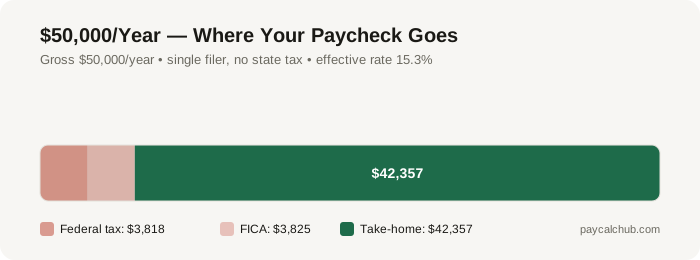
Gross pay and take-home pay are very different. After federal income tax, Social Security, and Medicare (FICA), a single filer earning $50,000 takes home approximately $42,214 per year — about $3,518 per month.
| Gross annual income | $50,000 |
| Standard deduction (2026) | -$15,000 |
| Taxable income | $35,000 |
| Federal income tax (10% + 12%) | -$3,818 |
| Social Security (6.2%) | -$3,100 |
| Medicare (1.45%) | -$725 |
| Effective federal rate | 15.3% |
| Federal take-home | $42,357/yr · $3,530/mo |
State income tax further reduces this. Here's how $50,000 compares across key states:
| Texas / Florida / Nevada (no state tax) | $42,214/yr · $3,518/mo |
| Arizona (2.5% flat) | $40,964/yr · $3,414/mo |
| Colorado (4.4% flat) | $39,964/yr · $3,330/mo |
| Georgia (5.49% flat) | $39,464/yr · $3,289/mo |
| Illinois (4.95% flat) | $39,739/yr · $3,312/mo |
| New York (graduated) | $38,714/yr · $3,226/mo |
| California (graduated) | $38,764/yr · $3,230/mo |
| Oregon (8.75% bracket) | $37,839/yr · $3,153/mo |
Is $50,000 a Good Salary in 2026?
Context matters enormously. Here's how $50,000 compares to key benchmarks:
- US median individual income: The median annual wage for full-time US workers is approximately $59,000. At $50,000, you're earning about 85% of the median — below average but within the normal range.
- US median household income: Approximately $77,000. A single earner at $50,000 is below the household median, but a two-income household where both earn $50,000 ($100,000 combined) is comfortably above it.
- MIT Living Wage: The living wage for a single adult ranges from $22/hour ($45,760/year) in states like Mississippi to $36/hour ($74,880/year) in coastal California. $50,000 ($24.04/hour) covers a living wage in most inland and Southern US markets.
- MIT Living Wage with one child: Ranges from $43,000 to $88,000 depending on state. $50,000 is tight or insufficient for a single parent in most markets.
The bottom line: $50,000 is a livable salary for a single adult in a low-to-moderate cost-of-living area. It becomes challenging in expensive cities (San Francisco, NYC, Seattle, Boston) and tight with dependents almost anywhere.
$50,000: The Number Most Career Advice Is Calibrated Around
$50,000/year is a frequently used benchmark in salary negotiation guides and career advice — partly because it's a round, easy-to-discuss number, and partly because it sits close to where many bachelor's-degree-holders land in their first 2-3 years. If you're using $50,000 as a negotiation anchor (current offer vs. asking price), it's worth knowing this is also the point where traditional vs. Roth 401k decisions start to matter more, since your marginal tax rate is high enough that the choice has real consequences.
Sample Monthly Budget on $50,000/Year
Using $3,518/month take-home (Texas, no state tax) as our baseline:
| Rent / housing (30%) | $1,055 |
| Groceries & food | $400 |
| Transportation (car payment + insurance + gas) | $450 |
| Utilities & phone | $180 |
| Health insurance / medical | $150 |
| Entertainment & subscriptions | $100 |
| Personal care & clothing | $80 |
| Savings (emergency fund + retirement) | $500 |
| Buffer / miscellaneous | $103 |
| Total | $3,018 |
This budget leaves $500 for savings — enough to contribute to a Roth IRA ($583/month maxes it) and begin an emergency fund. In a state with income tax, savings would need to be reduced by $100–$300/month.
How to Reach $50,000 — and Go Beyond
If you're currently earning less than $50,000 and targeting this benchmark, the most direct paths are:
- From $40,000: A 25% raise. Achievable through internal promotion (1–2 years), job change (most effective method), or adding a marketable certification in your field.
- From $35,000: A 43% increase. Usually requires either a significant role change or completing a degree or certification that unlocks a new job family.
- From $15/hour ($31,200/year): Adding skills like CDL licensing, phlebotomy certification, HVAC technician training, or CompTIA certifications can bridge this gap within 12–24 months.
The $50,000–$75,000 range is where the job market densest for skilled trades, experienced office workers, paraprofessional healthcare roles, and entry-level tech positions. Once at $50,000, the next meaningful threshold — $75,000 — typically requires specialization, management responsibility, or a bachelor's degree in a technical field.