$22 an Hour is How Much a Year?
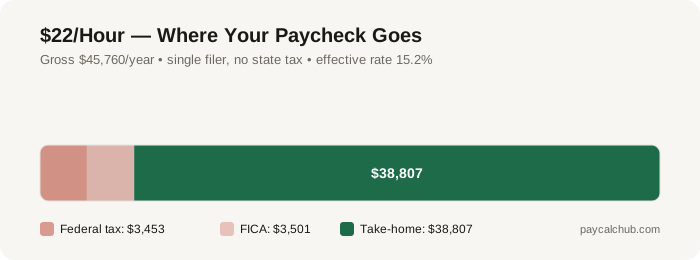
$22/hour × 2,080 hours = $45,760/year before taxes. After federal income tax and FICA, a single filer in a no-tax state takes home approximately $38,807/year ($3,234/month). This guide breaks down every pay period, why this rate sits right at the national median, and a realistic monthly budget.
$22 an Hour is How Much a Year?
Working full-time at $22/hour means $45,760 per year before taxes. Here is the full pay period breakdown:
| Hourly | $22 |
| Daily (8 hours) | $176.00 |
| Weekly (40 hours) | $880.00 |
| Bi-weekly (80 hours) | $1,760.00 |
| Semi-monthly (twice/month) | $1,906.67 |
| Monthly | $3,813.33 |
| Annual | $45,760 |
$22 an Hour After Taxes
Your actual take-home pay depends on your filing status, state, and deductions. For a single filer with no pre-tax deductions, here is what you keep after federal income tax and FICA:
| Gross annual income | $45,760 |
| Federal income tax (est.) | -$3,453 |
| FICA (Social Security + Medicare) | -$3,501 |
| State income tax (varies) | -$0 to -$4,576 |
| Annual take-home (no state tax) | $38,807 |
| Monthly take-home | $3,234 |
| Bi-weekly take-home | $1,493 |
| Effective federal + FICA rate | 15.2% |
After-Tax Pay by State
State income taxes vary significantly. Here is estimated annual take-home at $22/hr across key states (single filer, standard deduction):
| No state income tax (TX, FL, WA, NV…) | $38,807 |
| Pennsylvania (3.07%) | $37,402 |
| Illinois (4.95%) | $36,542 |
| Georgia (5.49%) | $36,295 |
| New York (est. 5.5%) | $36,290 |
| Virginia (5.75%) | $36,176 |
| California (est. 6.5%) | $35,833 |
Is $22 an Hour a Good Wage?
At $22/hr, a single adult can live comfortably in most US cities and begin building savings and retirement contributions.
For context, the federal minimum wage is $7.25/hour ($45,760 annualized vs. $15,080 for minimum wage). The US median individual wage is approximately $28/hour ($59,000/year) as of 2026. At $22/hr, you are below the national median.
$22/Hour: Right at the National Wage Midpoint
$22/hr is unusually close to the actual median individual wage in the US, which means roughly half the workforce earns less than this and half earns more. That makes it a useful benchmark: if you're at $22/hr, you are not behind — you're squarely average, which is a different financial planning conversation than being at $18 or $35/hr.
Common roles at this exact rate (medical assistant, paralegal, bookkeeper — see the table above) share something specific: they're credential-gated but not degree-gated. A 6-12 month certificate program is usually the fastest lever to move up from here, faster than waiting for raises.
Sample Monthly Budget at $22/Hour
Here is a realistic monthly budget for a single adult earning $22/hr (taking home ~$3,234/month, no state tax):
| Monthly take-home | $3,234 |
| Rent (aim for 30% of gross) | $1,144 |
| Groceries + dining | $388 |
| Transportation | $323 |
| Utilities + phone + internet | $226 |
| Health + insurance | $194 |
| Savings + retirement (target 15%) | $485 |
| Remaining (discretionary) | $474 |
Is $22/Hour Enough to Live On?
At $22/hour, your monthly take-home is approximately $3,234 (no state tax). This is livable in most US cities outside of major coastal metros. Manageable with roommates in higher-cost areas.
Using the standard 30% housing rule, you can afford rent of up to $950/month. Here is how $22/hr compares to key benchmarks:
| Federal minimum wage | $7.25/hour · $3.0× minimum wage |
| US national living wage (single adult) | ~$21.18/hour · You earn more |
| US median individual wage | ~$28/hour · 21% below the median |
| MIT Living Wage (avg US city, single adult) | ~$44,000/year · Your income is above this threshold |
Jobs That Pay Around $22/Hour
To contextualize what $22/hr represents in the job market, here are common occupations with median pay near this rate:
| Medical assistant | ~$22/hour · ~$45,760/year |
| HVAC technician (entry) | ~$22/hour · ~$45,760/year |
| Paralegal | ~$23/hour · ~$47,840/year |
| Bookkeeper | ~$22/hour · ~$45,760/year |
| Phlebotomist | ~$20/hour · ~$41,600/year |
What $22/Hour Looks Like Over a Career
Assuming 3% annual raises and consistent full-time work:
| Today ($22/hr) | $45,760/year |
| After 3 years (~$23.98/hr) | $49,878/year |
| After 5 years (~$25.52/hr) | $53,082/year |
| After 10 years (~$29.48/hr) | $61,318/year |
This range is typical for skilled trade apprentices and early-career healthcare workers. Completing journeyman certification or a bachelor's degree opens the $28–$35/hr range.
Where Does $22/Hour Go Furthest?
The same $22/hr wage delivers dramatically different living standards depending on where you live. The key metric: how many months of rent does your annual net pay cover?
Best Cities for $22/Hour
| Indianapolis, IN | $37,200 net · $900/mo rent · 41.3 months rent covered · flat 3.05% IN state tax, rent under $1,000 for a decent apartment |
| Oklahoma City, OK | $38,807 net · $850/mo rent · 45.7 months rent covered · no income tax burden, housing among cheapest in the US |
| Knoxville, TN | $38,807 net · $850/mo rent · 45.7 months rent covered · TN has no income tax, low housing costs, growing job market |
Toughest Cities at $22/Hour
| Seattle, WA | $38,807 net · $1900/mo rent · 20.4 months rent covered · while WA has no income tax, Seattle rent has surged above $1,900 |
| Denver, CO | $37,600 net · $1700/mo rent · 22.1 months rent covered · Colorado's 4.4% rate plus rising Denver rents tighten the budget |
| Austin, TX | $38,807 net · $1600/mo rent · 24.3 months rent covered · no TX tax helps, but Austin rent has doubled since 2019 |
At $22/hr, you're above the living wage in most Midwest and South cities — but still struggling in fast-growing Sun Belt metros where rents have outpaced wage growth since 2020.