$20 an Hour is How Much a Year?
$20/hour × 2,080 hours = $41,600/year before taxes. After federal income tax and FICA, a single filer in a no-state-tax state takes home approximately $34,800/year ($2,900/month). This guide covers every pay period, after-tax take-home by state, what $20/hr realistically buys in 2026, and the most direct paths to $30+/hr from here.
$20 an Hour is How Much a Year?
At 40 hours per week across 52 weeks (2,080 hours), $20/hour = $41,600/year gross. Full pay period breakdown:
| Hourly | $20.00 |
| Daily (8 hours) | $160.00 |
| Weekly (40 hours) | $800.00 |
| Bi-weekly (80 hours) | $1,600.00 |
| Semi-monthly | $1,733.33 |
| Monthly | $3,466.67 |
| Annual | $41,600.00 |
$20 an Hour After Taxes (2026)
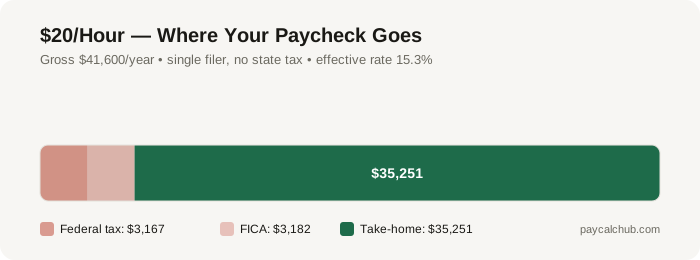
For a single filer with the standard deduction ($14,600) and no pre-tax deductions:
| Gross annual income | $41,600 |
| Federal income tax (est.) | -$3,167 |
| FICA (Social Security + Medicare) | -$3,182 |
| State income tax (varies) | -$0 to -$3,600 |
| Annual take-home (no state tax) | $35,251 |
| Monthly take-home | $2,938 |
| Bi-weekly take-home | $1,356 |
| Effective federal + FICA rate | 15.3% |
| No state tax (TX, FL, WA, NV…) | $35,251/year · $2,938/month |
| Pennsylvania (3.07%) | $33,974/year · $2,831/month |
| Illinois (4.95%) | $33,190/year · $2,766/month |
| New York (est. 5.5%) | $32,961/year · $2,747/month |
| California (est. 6.0%) | $32,752/year · $2,729/month |
Is $20 an Hour a Good Wage in 2026?
$20/hr ($41,600/year) is above the federal minimum wage but below the US individual median income (~$28/hr). In real terms:
- Livable with discipline: Lower-cost markets in the South and Midwest — Mississippi, Arkansas, rural Ohio, parts of Texas. Requires careful budgeting; savings are possible but limited.
- Very tight: Most mid-size cities — Columbus, Indianapolis, Denver, Nashville. Roommates or a second income significantly change the picture.
- Not viable solo: High-cost metros — San Francisco, NYC, Seattle, LA, Boston. $20/hr is effectively the minimum wage floor in California; solo living on this income in major metros requires substantial compromises.
Context: as of 2026, California's minimum wage is $17/hr and heading higher, meaning $20/hr is only $3 above the legal minimum in that state. In lower-cost states where minimum wage is still $7.25–$12, $20/hr represents a more meaningful income premium.
$20/Hour: The Most Common "Stuck" Wage in America
$20/hr is one of the most heavily populated wage points in the US — it's where a huge share of retail management, skilled customer service, and early-career trades workers plateau for years. Unlike $18/hr (which is often a first job) or $25+/hr (often post-certification), $20/hr is frequently a plateau wage: the rate you reach quickly, then stay at for 2-3 years without a clear next step.
The data point worth sitting with: moving from $20 to $25/hr is a 25% raise, but it usually requires a credential (forklift cert, Section 8 housing inspector license, EMT-B, etc.) rather than just tenure. Tenure alone tends to top out around $21–22/hr.
Sample Monthly Budget on $20/Hour
| Monthly take-home | $2,938 |
| Rent (target under $980) | $980 |
| Groceries + dining | $380 |
| Transportation | $320 |
| Utilities + phone + internet | $260 |
| Health + insurance | $180 |
| Savings (target $200/month) | $200 |
| Remaining (discretionary) | $618 |
This budget works only if rent stays under $980/month — which rules out most major cities. In markets where a one-bedroom runs $1,400+, $20/hr requires roommates to make the numbers work.
Jobs That Pay Around $20/Hour
| Medical assistant | ~$19–$22/hour |
| Administrative assistant (experienced) | ~$19–$23/hour |
| Warehouse supervisor | ~$19–$23/hour |
| Pharmacy technician (certified) | ~$18–$22/hour |
| Security officer (licensed) | ~$18–$22/hour |
| Childcare worker (lead teacher) | ~$17–$21/hour |
How to Move from $20 to $30+/Hour
The gap from $20/hr to $30/hr adds roughly $850/month in take-home — enough to fundamentally change your financial situation. Most direct paths:
- Skilled trades apprenticeship: Electrician, plumber, HVAC, and welder apprenticeships typically start at $18–$22/hr and reach $35–$50/hr within 4–5 years. Most programs are paid — you earn while you learn.
- Healthcare credentials: A 2-year nursing degree (ADN) or certified respiratory therapist program moves workers from $20/hr roles into $28–$40/hr positions. Community college programs are relatively affordable.
- IT certifications: CompTIA A+, Network+, or Security+ can push entry-level IT support from $18–$22/hr to $25–$35/hr within 12–18 months of study.
- Overtime strategy: At $20/hr, your overtime rate is $30/hr. Working a consistent 10 hours/week overtime adds $15,600/year gross — effectively a 37% income increase without changing jobs or careers.