$70,000 a Year is How Much an Hour?
$70,000/year ÷ 2,080 hours = $33.65/hour before taxes. After federal income tax and FICA, a single filer in a no-tax state takes home approximately $57,631/year ($4,803/month). This breaks down every pay period and how state taxes can shift what $70,000/year actually means for your lifestyle.
$70,000 a Year is How Much Per Hour?
Working full-time (40 hours/week, 52 weeks/year = 2,080 hours), a $70,000/year salary equals $33.65/hour. Here is the full pay period breakdown:
| Hourly rate | $33.65 |
| Daily (8 hours) | $269.20 |
| Weekly (40 hours) | $1346.15 |
| Bi-weekly (80 hours) | $2692.31 |
| Semi-monthly | $2916.67 |
| Monthly | $5,833.33 |
| Annual | $70,000 |
$70,000 a Year After Taxes
For a single filer with the standard deduction and no pre-tax deductions:
| Gross annual income | $70,000 |
| Federal income tax (est.) | -$7,014 |
| FICA (Social Security + Medicare) | -$5,355 |
| State income tax (varies) | -$0 to -$6,300 |
| Annual take-home (no state tax) | $57,631 |
| Monthly take-home | $4,803 |
| Bi-weekly take-home | $2,217 |
| Effective federal + FICA rate | 17.7% |
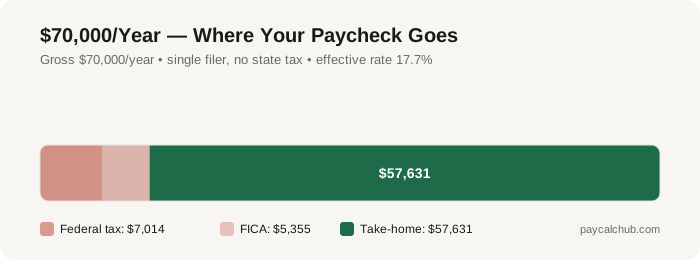
| No state tax (TX, FL, WA, NV…) | $57,631/year · $4,803/month |
| Pennsylvania (3.07%) | $55,482/year |
| Illinois (4.95%) | $54,166/year |
| New York (est. 5.5%) | $53,781/year |
| Virginia (5.75%) | $53,606/year |
| California (est. 6.5%) | $53,081/year |
Is $70,000 a Year a Good Salary?
$70,000/year ($33.65/hour) is above the US median and comfortable in most US markets. Homeownership is achievable in many cities, and savings goals are realistic.
Using the 30% housing rule, you can afford rent up to $1,750/month. Targeting 10% savings yields $480/month — enough to build an emergency fund and begin retirement contributions.
$70,000: Entering the Range Where State Taxes Meaningfully Diverge
At $70,000/year, the dollar difference between living in a no-income-tax state (Texas, Florida, Washington) versus a high-tax state (California, New York) becomes large enough to factor into relocation or remote-work negotiations — often $3,000-5,000/year in take-home pay. If you're weighing a remote job that lets you choose where you live, this is the income level where that choice starts to carry real financial weight.
Jobs That Pay Around $70,000/Year
| Registered nurse (median) | ~$35/hour · ~$72,800/year |
| Accountant (mid-level) | ~$33/hour · ~$68,640/year |
| Software developer (junior) | ~$38/hour · ~$79,040/year |
| Physical therapist assistant | ~$32/hour · ~$66,560/year |
| Construction manager (entry) | ~$33/hour · ~$68,640/year |
Sample Monthly Budget on $70,000/Year
| Monthly take-home | $4,803 |
| Rent (30% of gross) | $1,750 |
| Groceries + dining | $576 |
| Transportation | $480 |
| Utilities + phone + internet | $336 |
| Health + insurance | $288 |
| Savings (target 10%) | $480 |
| Remaining (discretionary) | $893 |
How to Move from $70,000 to $100,000
If $70,000/year ($33.65/hr) feels like a ceiling, here are the most realistic paths to the next level ($100,000/year — $48.08/hr):
- Target senior or lead roles: The jump from $70k to $100k is usually tied to a title change: Senior Analyst → Lead Analyst, Manager → Senior Manager. Start positioning for the next title 12–18 months before you want the raise.
- Move to a higher-paying industry or company tier: A $70k marketing role at a mid-size company might pay $95k–$110k at a tech company or investment bank for comparable work. Industry premium is often larger than merit raises.
- Earn an advanced credential: For roles where credentials matter (finance, engineering, healthcare, law), professional certifications or advanced degrees at this salary level typically deliver strong ROI within 3–5 years.
- Negotiate total compensation, not just salary: At $70k+, equity, bonus structure, and benefits become negotiable. A role with a $70k base + 15% bonus + equity is worth more than a $78k base with no extras.
Timeline: From $70,000, reaching $95,000–$100,000 typically takes 3–5 years through promotion or 1–2 strategic employer moves.