$100,000 a Year is How Much an Hour?
$100,000 a year — "six figures" — has long been a milestone salary goal for American workers. But how much is it really per hour? And in 2026, with inflation having significantly eroded purchasing power over the past five years, does $100,000 still feel like "a lot"? This guide gives you the full breakdown: hourly rate, every pay period, after-tax take-home in every state, and what a $100k salary actually buys in 2026.
$100,000 a Year is How Much an Hour?
The math: $100,000 ÷ 2,080 working hours per year (40 hrs/week × 52 weeks) = $48.08 per hour.
This assumes a standard full-time schedule with no unpaid leave. If you take 2 weeks of unpaid leave (1,920 working hours), your effective hourly rate rises to $52.08/hour — you earn the same annual amount in fewer hours.
| Hourly rate | $48.08/hr |
| Daily (8 hours) | $384.62 |
| Weekly (40 hours) | $1,923.08 |
| Bi-weekly (80 hours) | $3,846.15 |
| Semi-monthly (24 periods) | $4,166.67 |
| Monthly | $8,333.33 |
| Annual | $100,000 |
$100,000 After Taxes — What You Actually Take Home
Six figures sounds significant — and it is — but taxes take a meaningful bite. A single filer earning $100,000 pays federal income tax across multiple brackets, plus FICA, plus state income tax.
| Gross annual income | $100,000 |
| Standard deduction (2026) | -$15,000 |
| Taxable income | $85,000 |
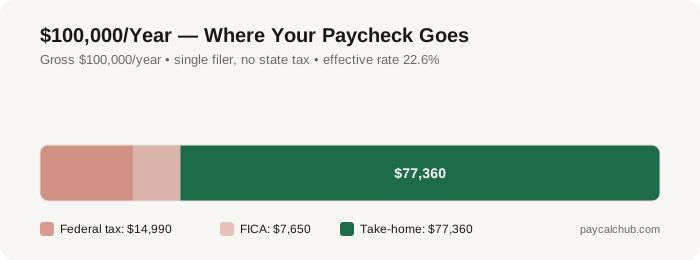
| Federal income tax (10% + 12% + 22%) | -$14,990 |
| Social Security (6.2%) | -$6,200 |
| Medicare (1.45%) | -$1,450 |
| Effective federal rate | 22.6% |
| Federal take-home (no state tax) | $77,360/yr · $6,447/mo |
State income tax reduces this further. Here's how $100,000 compares after all taxes across key states:
| Texas / Florida / Nevada (no state tax) | $78,009/yr · $6,501/mo |
| Washington (no income tax) | $78,009/yr · $6,501/mo |
| Arizona (2.5% flat) | $75,634/yr · $6,303/mo |
| Colorado (4.4% flat) | $73,609/yr · $6,134/mo |
| Georgia (5.49% flat) | $72,524/yr · $6,044/mo |
| Illinois (4.95% flat) | $73,059/yr · $6,088/mo |
| New York (graduated) | $69,634/yr · $5,803/mo |
| Oregon (8.75% bracket) | $69,384/yr · $5,782/mo |
| California (9.3% bracket) | $69,372/yr · $5,781/mo |
The gap between a zero-tax state and California at $100,000 is approximately $8,637/year — nearly $720/month. Over a decade, that's $86,370 in additional after-tax income, which invested at 7% annual return becomes roughly $121,000.
Is $100,000 Still a "Good" Salary in 2026?
Six figures used to be universally considered a "great" salary. In 2026, the picture is more nuanced:
- National context: $100,000 places you in approximately the top 20–25% of US individual earners. It is well above the US median individual wage (~$59,000) and above the median household income (~$77,000). By any national measure, it's a strong salary.
- Inflation impact: $100,000 in 2026 has the purchasing power of approximately $82,000 in 2020 after cumulative inflation of roughly 22%. The "feeling" of six figures has diminished meaningfully in expensive metros.
- Geography matters enormously: $100,000 is upper-middle-class comfort in Indianapolis or Memphis. It's solidly middle-class in Denver or Nashville. It's tight — possibly paycheck-to-paycheck — in San Francisco or Manhattan for someone with significant housing and childcare costs.
- MIT Living Wage: The living wage for a single adult ranges from $22/hour ($45,760/year) in the cheapest states to $36/hour ($74,880/year) in the most expensive. $100,000 comfortably exceeds the living wage everywhere in the US — for a single person.
$100,000: The Psychological Milestone That's Less Special Than It Feels
$100,000/year carries outsized cultural weight as "the six-figure salary," but the actual financial difference between $95,000 and $100,000 is marginal — about $3,600/year after taxes. The number matters more for negotiation leverage (a six-figure offer is psychologically easier to accept than $95k, even when the real difference is small) than for your actual budget. If you're negotiating toward exactly $100,000, know that the employer may have more room to move than the round number suggests.
Monthly Budget on $100,000 per Year
Using $6,501/month take-home (Texas, no state tax) as our baseline — here's a responsible budget at this income level:
| Housing (rent or mortgage PITI) | $1,800 |
| Groceries & food | $600 |
| Transportation (car + insurance + fuel) | $600 |
| Utilities, phone, internet | $250 |
| Health insurance (if not employer-paid) | $300 |
| Dining out & entertainment | $300 |
| Personal care & clothing | $150 |
| 401(k) contribution (10% of gross) | $833 |
| Roth IRA ($7,500/yr) | $625 |
| Emergency fund / other savings | $400 |
| Discretionary / travel | $300 |
| Total | $6,158 |
This budget maxes a Roth IRA, contributes significantly to a 401(k), and still leaves $440/month buffer. At this income level, maxing both a 401(k) ($24,500) and Roth IRA ($7,500) annually — $32,000 in total tax-advantaged savings — is achievable with disciplined budgeting.
What Jobs Pay $100,000 a Year?
The $100,000 threshold is reachable across a wide range of careers — not just technology and finance:
- Healthcare: Registered nurse (experienced, specialty), nurse practitioner, physician assistant, dental hygienist (senior/specialty markets), radiologic technologist (specialized)
- Technology: Software developer (mid-level), data analyst, cybersecurity analyst, cloud engineer, IT manager
- Skilled trades: Master electrician, master plumber, HVAC engineer, elevator mechanic, construction superintendent
- Finance & business: Financial analyst (senior), accountant (CPA), project manager (PMP certified), supply chain manager
- Education: University professor (most fields), school principal (large district), instructional coordinator (senior)
- Government & military: Federal law enforcement (experienced), military officer (O-4+), air traffic controller
How to Get to $100,000 From Where You Are
The path to $100,000 depends on your starting point:
- From $60,000–$75,000: A 33–67% raise. Most achievable through: a move to a higher-paying employer (job-switchers average 10–15% more), a promotion to a management or senior role, or adding a high-value certification (PMP, CPA, AWS, CISSP).
- From $40,000–$60,000: A significant career investment is usually required — a bachelor's degree in a technical field, a professional license (RN, PE, CPA), or several years in a high-growth industry.
- From $80,000–$90,000: You're close. Targeted negotiation, a single promotion, or a move to a higher-demand market (moving from a small city to a major metro) can close the gap within 1–2 years.