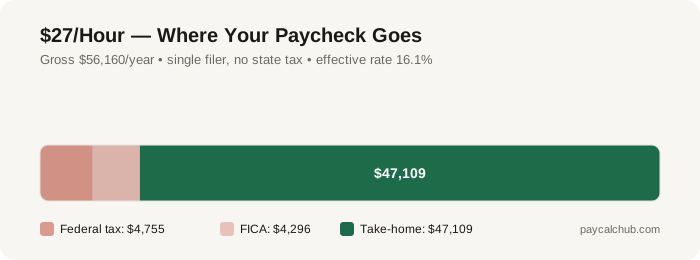
$27/hour × 2,080 hours = $56,160/year before taxes. After federal income tax and FICA, a single filer in a no-state-tax state takes home approximately $46,100/year ($3,842/month). This guide covers every pay period, after-tax take-home by state, a realistic monthly budget, and how to move from $27/hr to $35+/hr.
After-Tax Take-Home — $27/Hour, Single Filer (2026)
Gross annual income
$56,160
Federal income tax (est.)
-$4,755
FICA (Social Security + Medicare)
-$4,296
State income tax (varies)
-$0 to -$4,900
Annual take-home (no state tax)
$47,109
Monthly take-home
$3,926
Bi-weekly take-home
$1,812
Effective federal + FICA rate
16.1%
After-Tax Take-Home by State — $27/Hour, Single Filer (2026)
No state tax (TX, FL, WA, NV…)
$47,109/year · $3,926/month
Pennsylvania (3.07%)
$45,383/year · $3,782/month
Illinois (4.95%)
$44,330/year · $3,694/month
New York (est. 5.5%)
$44,020/year · $3,668/month
California (est. 6.2%)
$43,627/year · $3,636/month
Get your exact take-home: Use our Salary Calculator — select your state for your precise after-tax figure on $56,160/year.
Is $27 an Hour a Good Wage in 2026?
$27/hr ($56,160/year) is slightly above the US individual median income — comfortable in most mid-size markets, tight in high-cost cities. In practical terms:
Comfortable: Most Southern and Midwest markets — Memphis, Indianapolis, Oklahoma City, Omaha, El Paso. Independent living with savings is realistic.
Manageable: Mid-tier metros — Austin, Nashville, Phoenix, Denver. Renting is fine; buying requires planning.
Tight: High-cost metros — San Francisco, NYC, Seattle, Boston. Requires roommates or long commute for comfortable living.
$27/Hour: Above Median, Below "Comfortable"
At $27/hr, you're earning noticeably above the national median wage — but in high cost-of-living metros (Seattle, Denver, Austin), this rate still doesn't comfortably clear the 30%-of-income rent guideline for a one-bedroom apartment. This is the wage point where geography matters more than the number itself.
Workers at $27/hr in low cost-of-living states (Ohio, Tennessee, Oklahoma) are typically in a strong financial position; the same $27/hr in Seattle or San Francisco often still requires a roommate. Use the city comparison table above before assuming this wage means financial comfort.
Sample Monthly Budget on $27/Hour
Sample Monthly Budget — $27/Hour, Single Adult, No State Tax
Monthly take-home
$3,926
Rent (30% of gross)
$1,404
Groceries + dining
$450
Transportation
$370
Utilities + phone + internet
$270
Health + insurance
$200
Savings (target 10%)
$393
Remaining (discretionary)
$839
Jobs That Pay Around $27/Hour
Common Occupations Paying ~$27/Hour in 2026
Dental hygienist (entry)
~$26–$29/hour
Medical lab technician
~$25–$29/hour
Paralegal (mid-level)
~$26–$30/hour
Construction supervisor
~$25–$30/hour
Radiologic technologist (entry)
~$26–$30/hour
Insurance adjuster
~$25–$29/hour
How to Move from $27 to $35+/Hour
Targeted certification: Adding a high-value credential in your field typically moves $27/hr workers to $33–$40/hr within 12–18 months. CPhT → PharmD pathway, RN license for medical techs, or PMP for project management roles.
Employer switch: At $27/hr, switching employers yields 15–20% increases on average. The same role at a hospital system, tech company, or government agency often pays $32–$35/hr.
Overtime: At $27/hr, your overtime rate is $40.50/hr. Five overtime hours per week adds $10,530/year gross — a 19% income boost without changing jobs.
💡 Tax tip at $56k: At $56,160/year you're in the 22% federal bracket for the top portion of your income. Pre-tax 401(k) contributions save $0.22 per dollar contributed. Contributing $5,000 to a traditional 401(k) saves $1,100 in federal taxes immediately — and if your employer matches, it's the single highest-return financial move available.
Frequently Asked Questions
$27 an hour is how much a year? +
$27/hour × 2,080 hours = $56,160/year gross. Working 50 weeks gives $54,000/year. Part-time at 30 hrs/week equals $42,120/year.
What is take-home pay on $27 an hour? +
A single filer takes home approximately $47,109/year ($3,926/month) after federal income tax and FICA in a no-state-tax state. In states with income tax, expect $43,500–$47,100/year.
Is $27 an hour good pay in 2026? +
$27/hr ($56,160/year) is slightly above the US individual median income. It's comfortable in most mid-size US cities and tight in high-cost metros. It supports independent living with careful budgeting in most markets.
How much is $27 an hour biweekly after taxes? +
$27/hour biweekly gross (80 hours) = $2,160. After federal taxes and FICA for a single filer with no state tax, take-home is approximately $1,812 per biweekly paycheck.
How much house can I afford on $27/hour? +
At $56,160/year and 2026 mortgage rates (~6.5%), the 28% DTI rule allows roughly $1,311/month in housing costs, supporting a loan of approximately $207,000. With 10% down, that covers a home around $230,000 — achievable in many Midwest and Southern markets.
✎ Editor's Note — June 2026
$27/hr sits right around the US individual median in 2026, which makes it the income point where the "is this enough?" question comes up most often. The honest answer: it depends almost entirely on geography. In Indianapolis, Memphis, or El Paso, $27/hr is a genuinely comfortable income — enough to rent a decent one-bedroom, save $300–$400/month, and build financial stability over time. In Austin or Denver, it's livable but leaves little margin. In coastal cities, it's difficult solo. If you're at $27/hr and feeling financially squeezed in a mid-cost market, the issue may be fixable with a targeted credential or employer switch — the jump to $33–$35/hr is achievable within 12–18 months for most roles at this wage level.