$30 an Hour is How Much a Year?
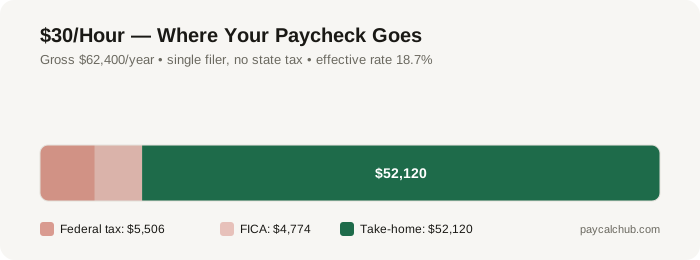
$30/hour × 2,080 hours = $62,400/year before taxes. After federal income tax and FICA, a single filer in a no-tax state takes home approximately $50,720/year ($4,227/month). This guide breaks down every pay period, after-tax take-home by state, a realistic monthly budget, and what $30/hr means in today's job market.
$30 an Hour is How Much a Year?
Working full-time at $30/hour means $62,400 per year before taxes. Here is the full pay period breakdown:
| Hourly | $30.00 |
| Daily (8 hours) | $240.00 |
| Weekly (40 hours) | $1,200.00 |
| Bi-weekly (80 hours) | $2,400.00 |
| Semi-monthly (twice/month) | $2,600.00 |
| Monthly | $5,200.00 |
| Annual | $62,400 |
$30 an Hour After Taxes
Your actual take-home depends on your filing status, state, and deductions. For a single filer with no pre-tax deductions:
| Gross annual income | $62,400 |
| Federal income tax (est.) | -$5,506 |
| Social Security (6.2%) | -$3,869 |
| Medicare (1.45%) | -$905 |
| Texas / Florida / Nevada (0%) | $0 |
| Annual take-home (no state tax) | $50,720 |
| Monthly take-home | $4,227 |
| Bi-weekly take-home | $1,951 |
| Weekly take-home | $976 |
| Effective federal + FICA rate | 18.7% |
$30 an Hour After Taxes by State
| Texas / Florida / Nevada (0%) | $50,720/yr · $4,227/mo |
| Washington (0%) | $50,720/yr · $4,227/mo |
| Colorado (4.4%) | $47,974/yr · $3,998/mo |
| Illinois (4.95%) | $47,631/yr · $3,969/mo |
| Michigan (4.25%) | $48,067/yr · $4,006/mo |
| Georgia (5.49%) | $47,294/yr · $3,941/mo |
| Virginia (5.75%) | $47,132/yr · $3,928/mo |
| New York (6.85%) | $46,444/yr · $3,871/mo |
| Oregon (8.75%) | $45,258/yr · $3,772/mo |
| California (9.3%) | $44,916/yr · $3,743/mo |
The difference between Texas (0% state tax) and California (9.3%) at $30/hr is approximately $5,804/year — purely due to state income tax. That's nearly $484/month more in take-home pay for the same wage.
Single vs Married Filing Jointly at $30/Hour
| Single | Married (MFJ) | |
| Standard deduction | $15,000 | $30,000 |
| Federal income tax | $5,506 | $3,360 |
| FICA | $4,774 | $4,774 |
| Annual take-home | $50,720 | $52,466 |
| Monthly take-home | $4,227 | $4,372 |
Is $30 an Hour a Good Wage?
$30/hr is above the US median hourly wage of approximately $23/hour. At $62,400/year, you are earning more than the median full-time worker in the US. This puts $30/hr firmly in the comfortable middle-income range.
Whether it feels like enough depends entirely on location. In Texas, Ohio, Tennessee, or the Carolinas, $4,227/month take-home covers rent, food, transport, and savings comfortably for a single person. In San Francisco, NYC, or Seattle, $30/hr is tight — housing can consume 60–70% of take-home pay in those markets.
$30/Hour: The Threshold Skilled Trades Target
$30/hr ($62,400/year) is a commonly cited target wage in skilled trades training programs, union apprenticeships, and many technical certificate programs — it's the number recruiters for electrician, plumbing, and HVAC apprenticeships often use to market the field. Reaching $30/hr without a four-year degree is realistic in trades, but the timeline matters: most apprenticeships take 3-5 years to get from entry wage to the $30/hr journeyman rate.
If you're evaluating whether a trade apprenticeship is worth it, $30/hr at year 4-5 (debt-free) compares very favorably to a four-year degree path that often starts new grads at a similar wage but with $30,000+ in student loans.
Sample Monthly Budget at $30/Hour
| Rent (30% of take-home) | $1,268/mo |
| Groceries + dining | $500/mo |
| Transportation | $420/mo |
| Utilities + phone + internet | $280/mo |
| Health + insurance | $250/mo |
| Savings + retirement (15%) | $634/mo |
| Remaining (discretionary) | $875/mo |
The $634/month savings allocation is enough to max out a Roth IRA ($583/month for the $7,500 annual limit) and still have $51/month left for emergency fund contributions. At $30/hr, building a meaningful financial foundation is realistic with consistent effort.
Overtime at $30/Hour
Under the FLSA, non-exempt workers earning $30/hr are entitled to $45/hr for every hour over 40 per week. Working just 5 extra hours per week adds $11,700/year in gross pay — boosting total earnings from $62,400 to $74,100.
| Regular (40 hrs/week) | $62,400/yr |
| 45 hrs/week (5 hrs OT) | $74,100/yr |
| 50 hrs/week (10 hrs OT) | $85,800/yr |
| OT rate (1.5×) | $45.00/hr |
Jobs That Pay $30/Hour
Common occupations at this pay level include:
- HVAC technician — $26–$40/hr depending on experience and location
- Electrician (journeyman) — $30–$48/hr union and non-union
- Registered nurse (entry) — $30–$40/hr in most markets
- IT support specialist — $25–$38/hr with CompTIA certifications
- Commercial truck driver (CDL-A) — $28–$42/hr depending on cargo type
- Dental hygienist — $32–$48/hr (requires 2-year associate's degree)
- Police officer — $28–$38/hr in most jurisdictions
Most of these roles are accessible without a 4-year degree. See our full guide: $30/Hour Jobs Without a Degree.